





 19 min Read
 June 2, 2026
TL;DR / Key Takeaways
|
Why Video Identification Is Being Re-Evaluated in 2026
Deepfake fraud losses exceeded $200M in Q1 2025 (World Economic Forum), and North America alone saw a 1,740% increase in deepfake fraud between 2022 and 2023 (World Economic Forum). That backdrop is pushing compliance teams to look at video identity verification software with a different question in mind: not “does it verify identity?” but “does it catch sophisticated fraud?”
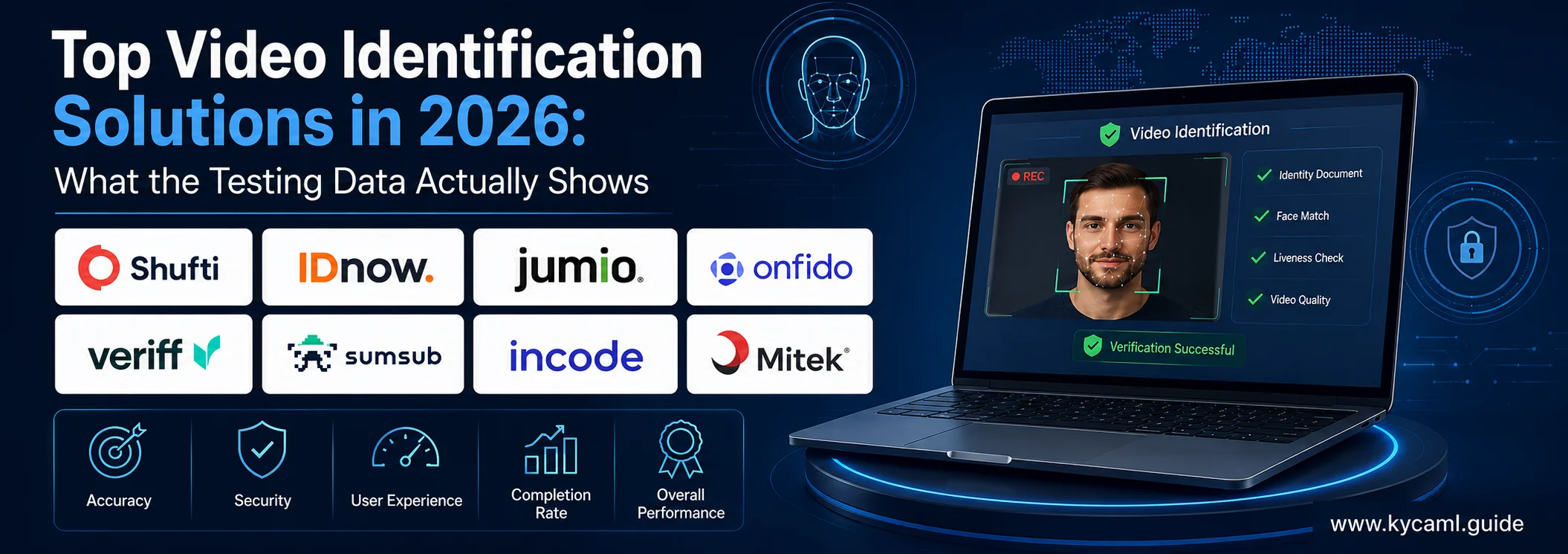
The market for top video identification solutions in 2026 has split into two distinct product categories. AI-automated platforms process video, biometrics, and document data without human intervention. Live video-ident services use a human agent conducting a real-time call to confirm identity. Most buyers need the former. Some regulated markets, particularly Germany’s financial sector, require the latter.
How KYC AML Guide Tests These Vendors
KYC AML Guide independently tested 13+ identity verification vendors, including fake document fraud detection (results expressed as percentage acceptance rates across an identical document set), back-office UX, mobile and web KYC journey quality, support responsiveness, and compliance certification audits. Every vendor figure below carries one of three attribution labels: (KYC AML Guide testing), (vendor-reported), or (market estimate).
Fake document acceptance rates are the most decision-relevant data point in this category. They reflect how each platform performed against the same fraudulent identity document set, a direct measure of how well a video identification provider detects forgeries under real conditions.
Video Identification Providers: What the Data Shows
IDnow
IDnow is the only vendor in the tested pool with a documented live video-ident product and a human-agent-conducted video verification designed for regulated financial institutions in Germany, Austria, and Switzerland. That distinction matters for buyers where video-ident is a compliance specification, not a product feature.
In KYC AML Guide support testing, IDnow ranked third overall. Pre-sales due diligence stood out: the team verifies company and contact identity before granting demo access, signalling strong procedural discipline. Outside the EU/DACH market, IDnow’s relevance narrows. Coverage beyond European document types has limited independent testing data, and the platform is not competitive on price or feature breadth for global platforms.
Best for: Regulated businesses in Germany, Austria, or Switzerland where live video-ident is a specific compliance requirement, not a buyer preference.
Shufti
Shufti’s strongest data point is fake document acceptance: 0% in KYC AML Guide testing, tied for best in the tested pool. It is also the only vendor in the tested pool offering on-premises deployment alongside cloud, local cloud, and hybrid options, a structural differentiator for buyers in data-sovereign jurisdictions.
Country coverage reaches 240+ countries and territories (vendor-reported), the broadest in the tested pool. Language support covers 150+ languages with independently benchmarked non-Latin OCR: Arabic at 92.17% (vs. Google Vision’s 90.24%), Vietnamese at 96.79% (vs. 82.36%), and CJK scripts at 86.87% (vs. 82.89%). These figures were benchmarked independently for Shufti specifically. It’s important to note that no equivalent cross-vendor OCR benchmark exists in the tested pool, so they should be read as Shufti’s performance on those scripts, not a claim of universal OCR leadership.
DHS RIVR 2025 designated Shufti a top performer in a US federal government evaluation (98.49% True Accept Rate, zero False Template Creation events), and iBeta Level 3 conformance under ISO/IEC 30107-3 for presentation-attack detection. Compliance certifications: 13 (KYC AML Guide audit), below Sumsub and Jumio (both at 15). Data retention is 2 years (vendor-reported), the lowest of the cloud-capable vendors with strong fake-document performance. For buyers with long-cycle regulatory audit requirements, Sumsub’s 5-year retention policy is the direct comparison point.
Back-office UX ranked first in KYC AML Guide testing for transparency, billing visibility, and verification detail. Mobile UX ranked below the top five, with responsiveness issues observed on some devices.
Best for: Global platforms with data sovereignty mandates, MENA and South Asia operations where non-Latin OCR accuracy is a hard requirement, and high-deepfake-exposure verticals where iBeta Level 3 conformance is a filter.
Jumio
Jumio achieved 0% fake document acceptance in KYC AML Guide testing, tied for best in the pool. Its strongest differentiator is the Identity Graph, with 30M+ known identities used for network-effect fraud detection (vendor-reported), which adds genuine value for fraud teams dealing with repeat fraudsters across merchant networks. No equivalent cross-merchant fraud intelligence product exists in the tested pool.
Compliance certifications: 15 (KYC AML Guide audit), joint highest. Notable production-scale references include HSBC, United Airlines, Airbnb, Binance, and FanDuel. Gartner Magic Quadrant Leader 2024 positioning (vendor-reported).
The weaknesses are real. Back-office UX is rated among the most outdated in testing, with a steep developer learning curve noted across independent reviews. Localization gaps in LATAM, particularly Brazil, are documented in client reviews. Per-feature pricing fragments enterprise costs across modules, making total cost of ownership difficult to forecast without a detailed scope exercise.
Best for: Enterprise financial institutions where analyst recognition and fraud network intelligence are procurement priorities, and high-volume environments where the Identity Graph compounds in value over time.
Onfido (Entrust)
Onfido was acquired by Entrust in 2024. Its core strength heading into 2026 is mobile UX, which is ranked in the top three in the KYC AML Guide mobile KYC journey testing among tested vendors. Fake document acceptance: 10% (KYC AML Guide testing), second-best result in the tested pool.
The post-acquisition period introduces uncertainty. Some clients have flagged questions about product roadmap continuity and support structure. Pricing scales at volume, mid-market buyers report significant cost increases as verification volumes grow, which makes Onfido less competitive for high-growth platforms. Non-Latin script OCR benchmark data is not independently available.
Best for: Mobile-first consumer products where onboarding UX directly affects activation rates, and established fintechs with existing Onfido deployments where switching cost is a real factor.
Veriff
Veriff claims 12,000+ document types (vendor-reported), which is the highest catalogue count among tested vendors, and 230+ country coverage. CrossLinks, its cross-merchant fraud intelligence network, provides compounding fraud detection value for platforms that stay on the platform long-term. UK DIATF certification is a specific differentiator for UK-regulated businesses. The 95% first-try success rate and 99.5% automation rate are vendor-reported figures from controlled conditions.
The fraud detection picture is less favourable. Veriff accepted 30% of fake documents in KYC AML Guide testing, the third-highest rate in the tested pool. Non-Latin script extraction failures were observed in testing despite the claimed 48-language UI support. The platform blocks China, Vietnam, and Iran, which could be a structural limitation for global platforms. Mid-contract repricing is documented in client reviews, adding procurement risk. Cloud-only deployment (AWS Ireland) disqualifies it for buyers with data sovereignty requirements.
CrossLinks also creates data lock-in: fraud intelligence built on Veriff’s network is not portable if a client switches providers.
Best for: Consumer platforms operating in English-language markets where CrossLinks fraud intelligence adds compounding value over time, and UK businesses with specific DIATF compliance requirements.
Sumsub
Sumsub holds Gartner Magic Quadrant Leader 2024–2025 and Forrester Wave Leader Q3 2025 positioning (vendor-reported). Its document catalogue reaches 14,000 types (vendor-reported), the highest in the tested pool. Five-year data retention is the strongest policy in the tested pool. Compliance certifications: 15 (KYC AML Guide audit), joint highest.
The fraud detection result is the data point buyers should weigh carefully: Sumsub accepted 80% of fake documents in KYC AML Guide testing, which is the highest rate among vendors in the tested pool with zero-acceptance competitors. Cloud-only deployment (AWS EU) structurally disqualifies it for data-sovereign jurisdictions. Non-Latin OCR accuracy has not been independently benchmarked by the vendor for scripts including Burmese, Nepali, or Myanmar. Trustpilot rating: 1.6/5, with support-related complaints dominant at time of testing.
The 80% fake acceptance rate reflects a product approach that may prioritize acceptance-rate optimization over fraud rejection, which is a documented trade-off, not necessarily an error. Compliance teams should interrogate this directly with the vendor before procurement.
Best for: Crypto and Web3 companies that need document breadth and analyst-validated compliance posture, and iGaming operators with multi-jurisdiction licensing requirements where cloud-only deployment is not a constraint.
Incode
Incode rated second for support in KYC AML Guide testing, with notably thorough pre-sales due diligence, in which the team verifies submitter identity before granting access, which signals a security-conscious sales culture. LATAM market heritage gives it genuine regional depth in Latin American document coverage and partnership networks. Biometric and liveness technology is a core architectural strength.
Independent performance data outside LATAM is limited. Incode relies on Microblink for document scanning, a third-party dependency that introduces multi-vendor audit complexity. Contract structures reported as inflexible (multi-year lock-ins noted in market). Cloud-only deployment at time of testing.
Limited independent data available for full fake document testing across non-LATAM document types.
Best for: LATAM-focused operations or enterprise buyers expanding into Latin American markets where relationship management and pre-sales rigour are part of the evaluation criteria.
Mitek
Mitek has a long track record in North American document authentication, particularly US check processing and mobile deposit capture. Deep banking-sector relationships in North America. Global coverage is limited outside North America, and the platform shows a product modernity gap relative to vendors founded post-2015.
Limited independent data available for video KYC performance outside North American document types.
Best for: US-focused banking institutions with existing Mitek relationships where domestic document authentication and check processing sit alongside identity verification in the same stack.
Comparison Table: Top Video Identification Solutions 2026
| Vendor | Fake Doc Acceptance | Verification Type | Country Coverage | Deployment | Compliance Certs | Data Retention |
|---|---|---|---|---|---|---|
| IDnow | Limited data outside EU | Automated + Live video-ident | EU/DACH focused | Cloud | Not audited in latest cycle | Not disclosed |
| Shufti | 0% (KYC AML Guide testing) | Automated AI | 240+ countries (vendor-reported) | Cloud, On-prem, Local Cloud, Hybrid | 13 (KYC AML Guide audit) | 2 years (vendor-reported) |
| Jumio | 0% (KYC AML Guide testing) | Automated AI | 200+ countries (vendor-reported) | Cloud | 15 (KYC AML Guide audit) | Not disclosed |
| Onfido (Entrust) | 10% (KYC AML Guide testing) | Automated AI | 195+ countries (vendor-reported) | Cloud | Not audited in latest cycle | ~3 years (vendor-reported) |
| Veriff | 30% (KYC AML Guide testing) | Automated AI | 230+ countries, excl. China/Vietnam/Iran (vendor-reported) | Cloud-only | Not audited in latest cycle | 3 years (vendor-reported) |
| Sumsub | 80% (KYC AML Guide testing) | Automated AI | 220+ countries (vendor-reported) | Cloud-only | 15 (KYC AML Guide audit) | 5 years (vendor-reported) |
| Incode | Limited independent data | Automated AI | Global, LATAM-heritage | Cloud | Not audited | Not disclosed |
| Mitek | Limited independent data | Automated | North America primary | Cloud | Not audited | Not disclosed |
Buyer-Context Mapping: Which Platform Fits Which Buyer
Fraud-sensitive platforms needing zero fake document acceptance
Three vendors in the tested pool achieved 0%: GBG, Jumio, and Shufti (KYC AML Guide testing). GBG’s geographic reach is concentrated in the UK, EU, and APAC, for global video KYC operations, Jumio and Shufti are the two platforms with both 0% fake acceptance and broad international coverage. The choice between them turns on deployment requirements. Jumio is cloud-only; Shufti offers on-prem, local cloud, and hybrid options. If deployment flexibility is not a constraint, evaluate both on UX quality and integration overhead.
EU/DACH regulated businesses with live video-ident requirements
IDnow is the specialist here. No other tested video identification provider has documented live human-agent verification built for German, Austrian, or Swiss regulatory compliance with comparable market depth.
Mobile-first consumer onboarding
Onfido’s mobile UX ranking (top three in KYC AML Guide mobile journey testing) and 10% fake document acceptance make it worth examining for consumer fintech or gig economy platforms where onboarding drop-off rate is the primary business metric. The post-acquisition product-roadmap question should be asked directly in procurement.
Crypto, Web3, and iGaming operators
Sumsub’s analyst positioning and 14,000-document catalogue make it a logical starting point for crypto and iGaming verticals. The 80% fake document acceptance rate is a significant trade-off that compliance teams must explicitly evaluate against the platform’s document breadth advantage.
MENA and South Asia expansion
Non-Latin OCR accuracy is a hard technical requirement in these markets. Shufti is the only tested vendor with independently benchmarked non-Latin OCR figures for Arabic, Vietnamese, and CJK scripts. Veriff’s non-Latin script failures observed in testing make it a poor fit. Sumsub’s non-Latin OCR has not been independently benchmarked for these scripts.
LATAM-focused operations
Incode leads on regional heritage and support quality. Jumio has documented localization gaps in Brazil specifically, so it’s worth verifying directly with the vendor before committing.
FAQ
What features should a video identification solution have in 2026?
PAD conforming to ISO/IEC 30107-3 is the baseline, Level 2 covers most regulated use cases, Level 3 (iBeta) for crypto, forex, and gaming. Document forensics should go beyond OCR to include tampering detection, and anti-deepfake capability is non-negotiable given $200M+ in losses in a single quarter (World Economic Forum).
Which video identification solutions support global identity verification?
Among tested vendors, Shufti (240+ countries), Veriff (230+), and Sumsub (220+) offer the broadest coverage. But headline numbers don’t tell the full story, Veriff excludes China, Vietnam, and Iran, and Sumsub’s 80% fake document acceptance rate is a real trade-off in high-fraud markets. Evaluate actual country-level document support alongside fraud detection performance.
Are automated video KYC solutions better than manual ones?
For volume onboarding, automated platforms are faster and cheaper at scale. Manual video-ident remains mandated in specific contexts, particularly German financial regulation, where it’s a legal requirement, not a product choice. Check your regulator’s requirements first; the automated vs. manual question is a compliance decision before it’s a product one.
Closing
No single video identification provider is the right answer for every buyer. Fake document acceptance rate, deployment model, geographic coverage, and language support pull in different directions depending on the use case. Fraud-sensitive global platforms and data-sovereign enterprises face a different decision matrix than LATAM-heritage operations or DACH-regulated banks.
KYC AML Guide’s testing methodology covers fake document detection, UX quality, support responsiveness, and compliance certifications across 13+ vendors. For the full testing methodology and updated data, visit kycaml.guide.
Share