





 19 min Read
 June 15, 2026
TL;DR / Key takeaways
- Onfido (now part of Entrust since 2024) accepted 10% of fake documents in KYC AML Guide testing, the second-best fraud result in our tested pool. But it also accepted only 67% of genuine documents, which points to a false-rejection problem that costs onboarding conversions.
- The best Onfido alternatives depend on your primary filter. Three vendors hit 0% fake document acceptance in testing: GBG, Jumio, and Shufti (listed alphabetically because they tied).
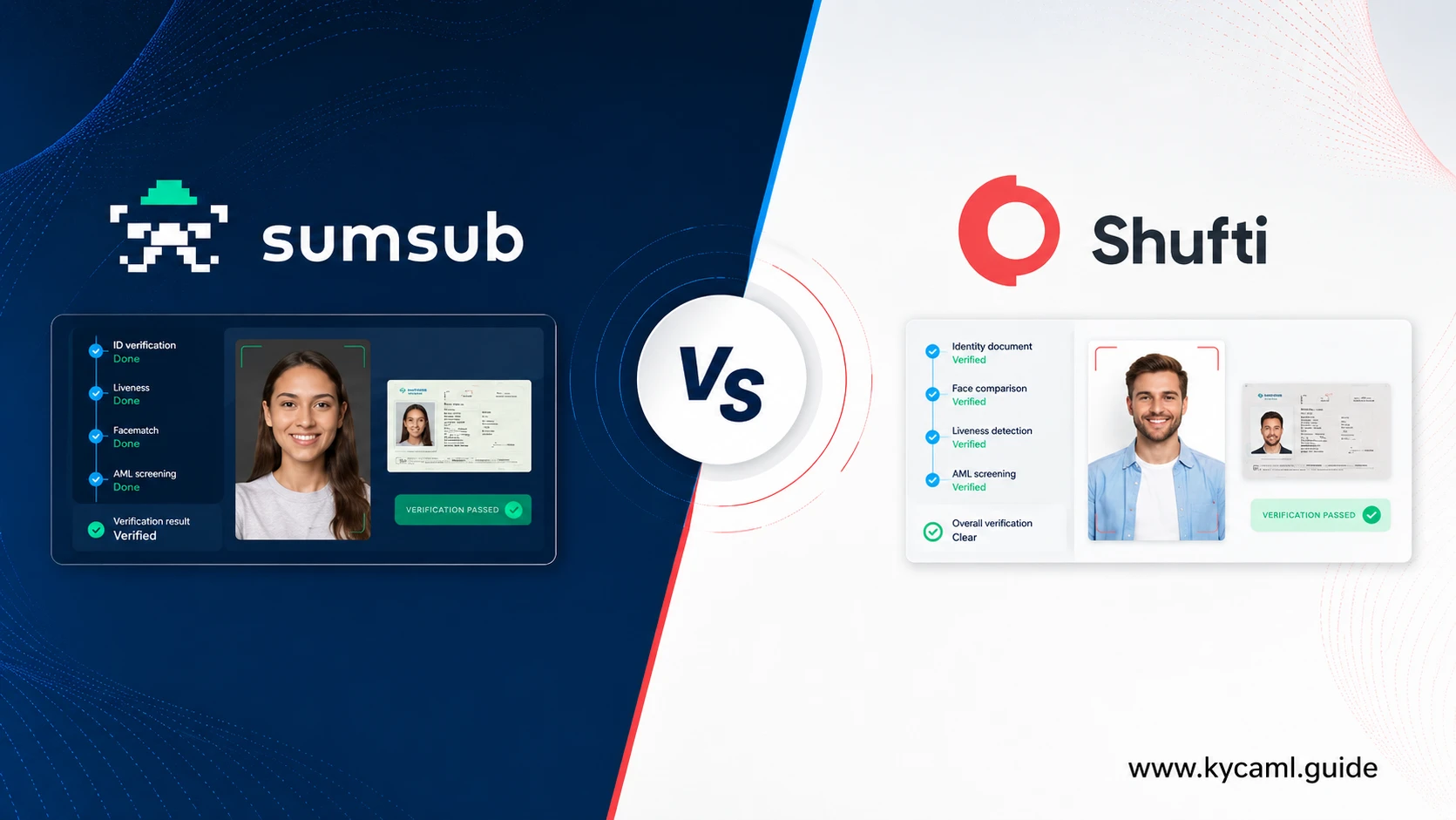
- If post-acquisition roadmap uncertainty is your reason for leaving Onfido, you are mainly choosing between Jumio and Sumsub for analyst-validated enterprise stability.
- Two popular Onfido competitors carry fraud trade-offs to interrogate directly: Sumsub accepted 80% of fake documents and Veriff accepted 30% (KYC AML Guide testing).
- No single vendor is the best alternative to Onfido for everyone. Match the vendor to your fraud tolerance, deployment model, geographic coverage, and procurement constraints.
Onfido built its reputation on mobile-first onboarding, and the 2024 acquisition by Entrust changed the calculus for a lot of buyers. Roadmap continuity, support structure, and pricing at scale are now open questions, and that is the usual trigger for a vendor review. If you are evaluating Onfido alternatives in 2026, the right replacement is not the one with the loudest marketing. It is the one whose tested performance matches your actual risk profile.
This roundup compares seven Onfido competitors using KYC AML Guide’s independent testing data: fake document acceptance, deployment models, coverage, data retention, and compliance certifications. We tested 13+ identity verification vendors against an identical battery of fraudulent and genuine documents, ran KYC journey UX testing on web and mobile, and contacted vendor support teams at odd hours and on public holidays to assess responsiveness. Every figure below carries its source label so you can see what came from testing versus what a vendor reported.
A note before the list: these entries are not ranked. Vendors with hard independent testing data appear first, and vendors with limited independent data appear lower, flagged as such. The order is about evidence, not a verdict.
Why buyers look for an alternative to Onfido?
Onfido is a capable platform, so it helps to be specific about what pushes teams to look elsewhere.
- Fraud detection is solid but not class-leading. Onfido accepted 10% of fake documents in KYC AML Guide testing, the second-best result in the tested pool. Three other vendors hit 0%. If document fraud is your primary risk, that gap matters.
- Genuine document rejection. Onfido accepted 67% of genuine documents in testing, the lowest genuine-acceptance figure we recorded among vendors tested on this dimension. High false rejection means real customers get turned away, which hits activation rates.
- Pricing scales fast. Mid-market buyers report significant cost jumps as verification volumes grow (KYC AML Guide vendor review).
- Post-acquisition uncertainty. Following the Entrust acquisition, the market is still watching for clarity on product roadmap and support continuity.
- Thin non-Latin OCR benchmarks. Publicly available OCR benchmark data for non-Latin scripts is limited, which is a question mark for buyers expanding into MENA, South Asia, or East Asia.
With those filters in mind, here are the alternatives worth examining.
The 7 best Onfido alternatives in 2026
Jumio
Jumio is the closest like-for-like alternative to Onfido for enterprise financial services, and it is one of three vendors that accepted 0% of fake documents in KYC AML Guide testing. Its Identity Graph draws on 30M+ known identities (vendor-reported) for network-effect fraud detection, which is a genuine differentiator if you are fighting repeat fraudsters across merchants. Jumio carries 15 compliance certifications (KYC AML Guide audit), tied for the highest count in our pool, and reference clients include HSBC, United Airlines, and Airbnb.
The trade-offs are real. Jumio’s backoffice UX rated among the most outdated in our testing, and developers face a steeper learning curve. Client reviews report localization gaps in LATAM, particularly Brazilian documents. Pricing is per-feature, so total cost fragments across modules and is hard to forecast without a detailed scope.
Best for: Enterprise banks and insurers where 0% fake acceptance, analyst recognition, and reference clients carry procurement weight, and where modern backoffice UX is not the top priority.
Sumsub
Sumsub is the Onfido competitor with the strongest analyst story: Gartner Magic Quadrant Leader 2024–2025 and Forrester Wave Leader Q3 2025 (vendor-reported). It offers one of the broadest document catalogues on the market at 14,000 document types (vendor-reported), 15 compliance certifications (KYC AML Guide audit), reusable KYC across connected platforms, and a 5-year data retention policy, the longest in our tested pool.
The fraud result is the headline caveat. Sumsub accepted 80% of fake documents in KYC AML Guide testing, the highest acceptance rate among vendors that had 0% competitors in the same pool. It also accepted 100% of genuine documents, so the pattern looks like deliberate acceptance-rate optimization rather than an error. That is a trade-off to weigh against your fraud tolerance, not an automatic disqualifier. Deployment is cloud-only on AWS EU, and entry pricing carries $149–$299/month minimums (vendor-reported).
Best for: Crypto, Web3, and iGaming operators that need document breadth, analyst-validated compliance posture, and reusable KYC, and that can interrogate the fake acceptance result directly with the vendor.
Veriff
Veriff leads our tested pool on raw document coverage at 12,000+ document types (vendor-reported) and reports a 6-second average verification, though real-world testing showed 30 seconds to 2 minutes. Its CrossLinks fraud network flags known patterns across Veriff’s client base, which compounds in value for high-volume consumer platforms. UK DIATF certification is a plus for UK regulated businesses.
Veriff accepted 30% of fake documents in KYC AML Guide testing, the third-highest in the pool. Deployment is cloud-only on AWS Ireland, with no on-prem option. Non-Latin script extraction failed in our testing despite a claimed 48-language UI. Pricing runs $0.80–$2.05 per check plus monthly minimums, and client reviews report mid-contract repricing, which is a procurement risk. Veriff also blocks China, Vietnam, and Iran, and CrossLinks fraud intelligence is not portable if you switch vendors.
Best for: English-language consumer platforms and marketplaces that need broad document coverage and benefit from a cross-merchant fraud network, and that are not exposed to data sovereignty or non-Latin OCR requirements.
Shufti
Shufti accepted 0% of fake documents in KYC AML Guide testing, tied for the best result in the pool, and also accepted 100% of genuine documents, so it avoids the false-rejection issue that pushes some teams away from Onfido. It reports the broadest geographic reach in our pool at 240+ countries and territories and 150+ languages (vendor-reported), and it was the only tested vendor offering on-premises deployment alongside cloud, local cloud, and hybrid. Its backoffice rated #1 in our testing for transparency and billing visibility, and its KYC web journey ranked #2. Shufti was a DHS RIVR 2025 Top Performer in the US federal government evaluation.
Be clear on the weaknesses. Shufti’s mobile UX ranked below the top 5 in our mobile KYC journey testing, with responsiveness issues on some devices, which matters if you are leaving Onfido specifically for its mobile strength. Its 10,000+ document types (vendor-reported, framed as actively verified) sit below Veriff and Sumsub on raw catalogue count. Its 13 compliance certifications (KYC AML Guide audit) trail Sumsub and Jumio at 15. And its 2-year data retention is shorter than Sumsub’s 5 years, which is a concrete disadvantage if you have long-cycle audit obligations.
Best for: Buyers with data sovereignty mandates needing on-prem deployment, or those expanding into MENA and APAC where non-Latin OCR accuracy and broad country coverage are hard requirements.
Trulioo
Trulioo rated #1 for support in KYC AML Guide testing, outperforming every other vendor on ticketing, follow-up, and proactive outreach. Its strength is global database verification across markets where document-based checks have friction, which makes it a fit when name and date-of-birth verification is the primary check rather than document forensics.
Two findings need flagging. Trulioo accepted 70% of fake documents in KYC AML Guide testing, the second-highest in the pool, so document fraud detection is not its strong suit. Its data retention is 72 hours, the shortest of any tested vendor by a wide margin, which is a structural problem in jurisdictions that require extended data preservation for AML audits.
Best for: Enterprise buyers where account management and onboarding support are heavily weighted, and where database-style identity verification outweighs document fraud detection.
GBG (GB Group)
GBG accepted 0% of fake documents in KYC AML Guide testing, tied for the best result alongside Jumio and Shufti. Founded in 1989, it brings a long enterprise track record and deep database verification in UK, EU, and APAC markets, with a strong reference base in the UK and ANZ.
The architecture is the limit. GBG’s address and identity products are database-only, with no document forensics or metadata layer, so they miss markets with thin bureau coverage: a market estimate puts 30–40% of addresses in MENA, LATAM, and Southeast Asia outside reliable database verification. GBG also rated lowest for support in our testing, citing internal coordination failures and duplicate outreach.
Best for: UK, EU, or APAC-focused enterprises in banking and insurance where database depth in those regions is the primary requirement and global expansion is not on the near-term roadmap.
IDnow
IDnow is the European specialist among Onfido competitors, rated #3 for support in KYC AML Guide testing. Its video-ident capability provides human-assisted, high-assurance identity proofing, which carries specific compliance weight in German regulated markets, and it shows strong procedural discipline in pre-sales due diligence. It also offers a verification wallet product.
The constraint is reach. IDnow is primarily an EU and DACH specialist, and coverage outside those markets is limited relative to global platforms. We have limited independent fake document data for IDnow outside European document types, so it sits lower here on evidence rather than on capability.
Best for: Regulated businesses in Germany, Austria, or Switzerland where video-ident is a compliance requirement and EU regulatory depth outweighs global coverage.
Onfido alternatives compared: the data table
| Vendor | Fake doc acceptance (KYC AML Guide testing) | Deployment | Coverage (vendor-reported) | Data retention | Compliance certs (KYC AML Guide audit) |
| Onfido (baseline) | 10% | Cloud | 195+ countries | ~3 years (vendor-reported) | Not audited latest cycle |
| Jumio | 0% | Cloud | 200+ countries, 5,000+ doc types | Not disclosed | 15 |
| Sumsub | 80% | Cloud-only | 220+ countries, 14,000 doc types | 5 years (vendor-reported) | 15 |
| Veriff | 30% | Cloud-only | 230+ countries, 12,000+ doc types | 3 years (vendor-reported) | Not audited (vendor: ISO 27001, SOC 2, ISO 30107-3, UK DIATF) |
| Shufti | 0% | Cloud, Local Cloud, On-Prem, Hybrid | 240+ countries and territories, 150+ languages | 2 years (vendor-reported) | 13 |
| Trulioo | 70% | Cloud | 195+ countries | 72 hours (vendor-reported) | Not audited latest cycle |
| GBG | 0% | Cloud | Strong UK/EU/APAC | Not disclosed | Not audited latest cycle |
| IDnow | Limited independent data | Cloud | EU/DACH focus | Not disclosed | Not audited latest cycle |
Read this as a set of trade-offs, not a leaderboard. A 0% fake acceptance vendor can still trail on mobile UX or document catalogue size, and a vendor with the broadest catalogue can carry the highest fake acceptance. Weight each column against your own risk profile.
Which Onfido alternative fits your use case?
No vendor wins across every dimension, so the useful question is which filter matters most for your team.
If document fraud detection is your primary filter.
Three vendors in the tested pool achieved 0% fake document acceptance: GBG, Jumio, and Shufti. If you are replacing Onfido specifically to close the fraud gap, those three are the serious candidates, and the right pick among them comes down to deployment and coverage needs below.
If you are leaving Onfido for post-acquisition stability and analyst validation.
Sumsub (Gartner and Forrester Leader) and Jumio (Gartner Leader, 15 certifications) carry the procurement-grade recognition that smooths enterprise sign-off. With Sumsub, raise the 80% fake acceptance result directly with the vendor before signing.
If you need on-premises deployment or data sovereignty.
Shufti was the only tested vendor offering on-prem alongside cloud, local cloud, and hybrid, and IDnow is the EU and DACH specialist where video-ident and regional regulatory depth are required. If deployment model is the hard constraint, those two define the shortlist.
If you are expanding into MENA, South Asia, or East Asia.
Non-Latin OCR accuracy becomes the filter. Shufti benchmarked Arabic at 92.17%, Vietnamese at 96.79%, and CJK at 86.87% against Google Vision (vendor-reported, independently benchmarked on those scripts), while Veriff showed non-Latin extraction failures in testing and Sumsub’s non-Latin OCR was not independently benchmarked. If non-Latin scripts are core to your roadmap, that is where to focus testing.
If you are LATAM-focused.
Incode brings LATAM heritage and strong biometrics, and Jumio has regional presence, though note the reported localization gaps in Brazilian documents. If the Latin American market is your priority, validate document coverage per country before committing.
If mobile onboarding UX is the reason you chose Onfido.
This is the honest hard case. Onfido ranked among the top three for mobile KYC journey in our testing, and few tested alternatives clearly beat it on mobile polish, so weigh any move carefully. Incode’s biometric and liveness strength is the most relevant angle here, but test the full mobile flow against your current Onfido baseline before switching.
What this comparison does not cover?
These results are directional. They reflect a specific battery of documents and may differ with other document types, regions, or fraud-sophistication levels, and pricing structures change, so confirm current terms with each vendor. Fraud is also a moving target: US AI-enabled fraud losses could reach $40 billion by 2027, up from $12.3 billion in 2023, a 32% CAGR (Deloitte Center for Financial Services), and the Q1 2025 quarter alone saw more than $200 million in deepfake fraud losses (World Economic Forum). With roughly 6 billion KYC checks projected annually by 2027 (industry analyst estimates), the cost of picking the wrong alternative to Onfido compounds quickly.
The takeaway holds: there is no single best alternative to Onfido. Match the vendor to your fraud tolerance, deployment model, geographic footprint, and procurement constraints, and pressure-test the testing data against your own document mix. For the full methodology behind these figures, see KYC AML Guide’s testing documentation.
Frequently asked questions
Who are Onfido’s main competitors in 2026?
The main Onfido competitors are full-platform identity verification vendors: Jumio, Sumsub, Veriff, Shufti, Trulioo, and GBG, plus regional specialists like IDnow (EU/DACH) and Incode (LATAM). They differ sharply on fraud detection, deployment, and coverage.
What is the best alternative to Onfido for fraud detection?
On fake document acceptance, three vendors tied at 0% in KYC AML Guide testing: GBG, Jumio, and Shufti, compared with Onfido’s 10%. The best fit among them depends on your deployment and coverage needs.
Why are companies switching away from Onfido?
Common reasons include uncertainty after the 2024 Entrust acquisition, pricing that scales quickly at volume, a 67% genuine document acceptance rate that can reject real customers, and limited non-Latin OCR benchmarks for global expansion.
Are there Onfido alternatives with on-premises deployment?
Among tested vendors, Shufti was the only one offering on-premises deployment alongside cloud, local cloud, and hybrid options. Most competitors, including Sumsub and Veriff, are cloud-only.
Share