





 18 min Read
 June 15, 2026
TL;DR / Key Takeaways
- KYC AML Guide independently tested 13+ identity verification vendors. Trulioo accepted 70% of fake documents, the second-highest rate in the tested pool.
- Trulioo’s 72-hour data retention policy is the shortest of any tested vendor, creating a structural compliance risk in jurisdictions that require extended AML audit records.
- Trulioo ranked first for support in KYC AML Guide testing. If enterprise account management and database verification are your primary filters, alternatives don’t uniformly outperform it.
- Three Trulioo competitors GBG, Jumio, and Shufti achieved 0% fake document acceptance in the same independent testing.
- The best alternative of Trulioo depends on your specific requirements: fraud detection accuracy, data retention duration, geographic coverage, mobile UX, or deployment flexibility.
Trulioo accepted 70% of fake documents in KYC AML Guide independent testing. That places it second-worst in a pool of 13+ tested vendors, behind only Sumsub (80%). Its 72-hour data retention policy is the shortest by a wide margin, a structural problem for buyers in regulated markets where Anti-Money Laundering (AML) audit obligations require weeks or months of data preservation.
None of this makes Trulioo a failed product. It ranked first in KYC AML Guide support testing: best ticketing system, most proactive follow-up, and the only vendor to self-initiate outreach on pending queries. Its global database verification network is a genuine advantage in markets where document-based KYC creates operational friction. For buyers where enterprise account management and name/date-of-birth-based verification carry the most weight, Trulioo remains competitive.
The problem is when a buyer’s actual risk profile doesn’t match those specific strengths. This guide maps the top Trulioo alternatives for buyers whose requirements fall in the gaps the testing data reveals.
How KYC AML Guide Tested These Vendors?
KYC AML Guide independently tested 13+ identity verification vendors using a battery of fraudulent and genuine documents, alongside web and mobile KYC journey evaluations, support testing at non-standard hours and public holidays, and a compliance audit covering 37 major certifications. Testing data is reported as percentages. Results are directional; they reflect a specific test battery and may differ across document types or fraud sophistication levels.
Top Trulioo Alternatives in 2026
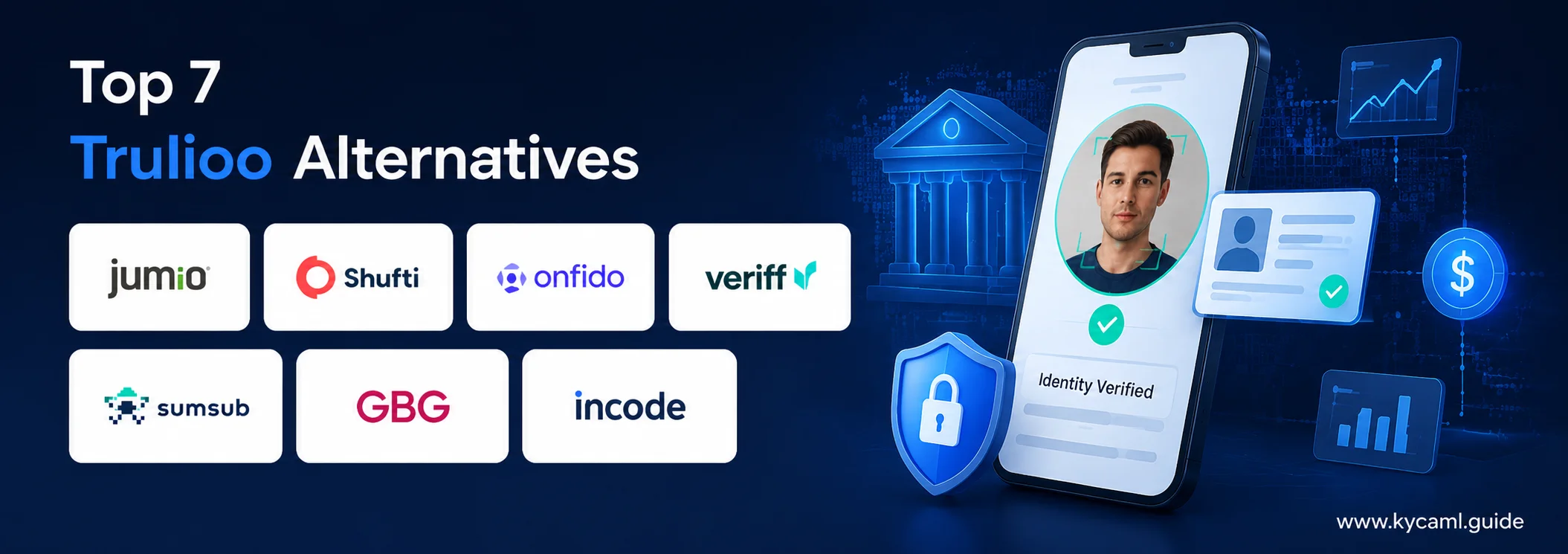
Jumio
Jumio achieved 0% fake document acceptance in KYC AML Guide testing tied for the lowest rate in the pool. For buyers whose primary driver for switching is document fraud detection, that result is the natural starting point.
Jumio’s Identity Graph adds a second fraud signal layer beyond document analysis: a network of 30M+ known identities (vendor-reported) that flags repeat fraudsters across Jumio’s merchant base even when a document passes forensic checks. For financial services teams processing high transaction volumes, that network-effect intelligence is a genuine differentiator.
The trade-offs are real. Jumio’s back office is rated among the least modern in KYC AML Guide testing. Its per-feature pricing model is difficult to forecast without a detailed scope, which complicates total cost of ownership modeling. Localization gaps exist in LATAM particularly Brazil per client reviews. Standard verification speeds vary from 6 seconds (vendor-reported) to 30–60 seconds in production environments.
Jumio holds 15 compliance certifications (KYC AML Guide audit) the joint highest in the tested pool alongside Sumsub, and carries Gartner Magic Quadrant Leader recognition (vendor-reported). For enterprise financial institutions where analyst positioning matters during procurement, those credentials carry weight.
Best for: Enterprise financial institutions prioritizing fraud network intelligence and analyst-validated compliance posture, where back office UX modernity is a secondary concern.
Shufti
Shufti achieved 0% fake document acceptance in KYC AML Guide testing the same result as GBG and Jumio. It also holds a DHS RIVR 2025 Top Performer designation from a US federal government evaluation, alongside iBeta Level 3 conformance under ISO/IEC 30107-3 for presentation-attack detection. Both are independently issued credentials, not vendor self-certifications.
The most structurally significant divergence from Trulioo is in deployment and data retention. Shufti is the only vendor in the tested pool offering cloud, local cloud, on-premises, and hybrid deployment. Buyers in data-sovereign jurisdictions India, Saudi Arabia, specific EU banking contexts have no comparable alternative in this test pool. Data retention is 2 years (vendor-reported), materially longer than Trulioo’s 72 hours, though shorter than Sumsub’s 5-year policy.
Its back office rated first in KYC AML Guide testing for transparency, billing visibility, and verification detail. Its web KYC journey ranked second overall. Mobile UX is below the top five, with responsiveness issues observed on some devices in testing.
Shufti’s weaknesses deserve the same directness applied to others. Its raw document catalogue 10,000+ types (vendor-reported) is framed as actively verified in production monthly, but sits below Veriff (12,000+) and Sumsub (14,000+) on raw count. Its 13 compliance certifications (KYC AML Guide audit) fall below Sumsub and Jumio (both at 15). The 2-year data retention is a concrete limitation for buyers with long-cycle audit requirements. Brand recognition in Western European and US enterprise procurement cycles is less mature than Jumio, Sumsub, or Veriff, a commercial gap, not a technical one.
Best for: Buyers in data-sovereign jurisdictions requiring on-prem deployment; MENA and APAC markets where non-Latin script accuracy is a hard requirement; cost-sensitive buyers who need pay-as-you-go pricing without monthly minimums.
Onfido (Entrust)
Onfido accepted 10% of fake documents in KYC AML Guide testing the second-best result in the pool and a material step up from Trulioo’s 70%. It ranked third overall in mobile KYC journey testing, making it relevant for consumer-facing products where onboarding flow directly affects activation rates.
Onfido was acquired by Entrust in 2024. The combined entity introduces enterprise access control heritage alongside identity verification potentially valuable for buyers already in Entrust’s ecosystem. The post-acquisition product roadmap is still stabilizing, and buyers should ask direct questions about long-term feature continuity during evaluation.
Pricing scales sharply at volume. Mid-market buyers report significant cost jumps as verification volumes grow a relevant modeling exercise for anyone calculating total cost of ownership beyond initial contract terms. Data retention is approximately 3 years (vendor-reported), well above Trulioo’s 72-hour floor.
Best for: Mobile-first consumer products where onboarding UX is an activation lever; buyers already inside the Entrust enterprise identity ecosystem.
Veriff
Veriff covers 12,000+ document types (vendor-reported) across 230+ countries, the broadest raw document catalogue among the Trulioo competitors tested. For buyers whose primary constraint is document breadth across a diverse global user base, that coverage is the relevant entry point.
CrossLinks, Veriff’s cross-merchant fraud intelligence network, flags known fraud patterns identified across its client base. For consumer platforms at scale, that compounding network effect improves over time. A 95% first-try success rate and 99.5% automation rate are vendor-reported figures worth interrogating directly in a proof of concept. Data retention is 3 years (vendor-reported).
The friction points are concrete. Veriff accepted 30% of fake documents in KYC AML Guide testing a meaningful gap from the vendors achieving 0%. Cloud-only deployment on AWS Ireland creates a structural disqualification for data sovereignty requirements. Non-Latin script extraction failures were observed in KYC AML Guide testing, limiting utility in MENA and South Asia. Veriff blocks China, Vietnam, and Iran, a dealbreaker for global platforms expanding into those markets. Mid-contract repricing has been reported in client reviews, which is a procurement risk.
Best for: Consumer platforms in English-language markets where CrossLinks fraud intelligence compounds over time; buyers for whom UK Digital Identity and Attributes Trust Framework (DIATF) certification is a specific regulatory requirement.
Sumsub
Sumsub’s document catalogue runs to 14,000 types (vendor-reported) the broadest in the tested pool. Gartner Magic Quadrant Leader 2024–2025 and Forrester Wave Leader Q3 2025 positioning (vendor-reported) give it the strongest analyst credential stack of any alternative tested. Its 5-year data retention policy is the longest in the pool a direct answer to Trulioo’s 72-hour structural gap for AML audit requirements.
The countervailing data is significant. Sumsub accepted 80% of fake documents in KYC AML Guide testing a higher acceptance rate than Trulioo’s 70%. Buyers switching specifically because of document fraud concerns should note that Sumsub performs worse on that dimension, not better.
Sumsub is cloud-only (AWS EU), which disqualifies it for data sovereignty mandates. Its Trustpilot rating was 1.6/5 at the time of testing, with support-related complaints the dominant theme in public reviews. Entry-tier monthly minimums of $149–$299 (vendor-reported) are a factor for cost-sensitive buyers. For buyers where document breadth, analyst validation, and 5-year data retention are the primary filters and where document fraud detection accuracy is secondary, Sumsub has a credible case.
Best for: Crypto and Web3 companies needing the broadest document catalogue and analyst-validated compliance posture; regulated buyers where 5-year data retention is a hard contractual or regulatory requirement.
GBG (GB Group)
GBG achieved 0% fake document acceptance in KYC AML Guide testing the same result as Jumio and Shufti. Its competitive zone is UK, EU, and APAC, where its database verification depth represents a genuine advantage over alternatives. A long enterprise track record in banking, insurance, utilities, and telecommunications in those markets is a credible procurement signal.
Outside that geographic zone, GBG’s relevance narrows sharply. It operates a database-only architecture in address and identity verification products, with no document forensics or metadata analysis layer. An estimated 30–40% of addresses in MENA, LATAM, and Southeast Asia fall outside reliable bureau coverage (market estimate), which limits its utility for global expansion use cases.
GBG rated lowest for support in KYC AML Guide testing. Internal coordination failures and duplicate outreach from different team members were observed during the evaluation process.
Best for: UK, EU, or APAC-focused buyers where GBG’s database depth in those markets is the primary filter, with limited or no global expansion requirements.
Incode
Incode ranked second in KYC AML Guide support testing, the closest parallel to Trulioo’s support-first profile among the alternatives evaluated. Its pre-sales process is notably rigorous: Incode verifies the identity of contact form submitters before granting demo access and proactively reaches out before the first call. For buyers where the sales and onboarding process carries evaluation weight, that consistency is worth noting.
Incode’s core market is LATAM, with a growing enterprise presence in North America. Its biometric and liveness technology is architecturally strong. Document scanning is handled via Microblink, a third-party dependency that introduces audit complexity for buyers who need to interrogate individual verification decisions at the component level. Contract structures have been reported as inflexible (multi-year lock-ins noted in market).
Independent performance data outside Incode’s home markets is limited, which is why it appears lower in this comparison where direct testing data is the primary ranking input.
Best for: LATAM-focused operations and enterprise buyers where pre-sales rigor and relationship management are explicit evaluation criteria.
Head-to-Head Comparison: Trulioo vs. Top Alternatives
| Vendor | Fake Doc Acceptance | Data Retention | Deployment | Document Types | Compliance Certs |
| Trulioo | 70% | 72 hours | Cloud | Not disclosed | Not audited |
| GBG | 0% | Not disclosed | Cloud | Not disclosed | Not audited (latest cycle) |
| Jumio | 0% | Not disclosed | Cloud | 5,000+ | 15 |
| Shufti | 0% | 2 years | Cloud / On-Prem / Local Cloud / Hybrid | 10,000+ | 13 |
| Onfido (Entrust) | 10% | ~3 years | Cloud | Not disclosed | Not audited (latest cycle) |
| Veriff | 30% | 3 years | Cloud | 12,000+ | Not audited (latest cycle) |
| Sumsub | 80% | 5 years | Cloud | 14,000+ | 15 |
| Incode | Limited data | Not disclosed | Cloud | Not disclosed | Not audited |
Fake document acceptance: KYC AML Guide independent testing. Document types, data retention, deployment: vendor-reported. Compliance certifications: KYC AML Guide audit where noted.
Which Trulioo Competitor Fits Your Buyer Profile?
Fraud detection is your primary requirement
Three vendors in the tested pool achieved 0% fake document acceptance: GBG, Jumio, and Shufti. Onfido achieved 10%. If Trulioo’s 70% result is the primary driver for this evaluation, these are the vendors to examine first. Note that Sumsub’s 80% result means it performs worse than Trulioo on this specific dimension.
Data retention for AML audit compliance
Trulioo’s 72-hour retention is incompatible with most regulated AML audit obligations. Sumsub (5 years), Veriff and Onfido (approximately 3 years), and Shufti (2 years) all substantially outperform it. Determine what your regulatory minimum actually requires before shortlisting the answer narrows the field directly.
On-premises or data-sovereign deployment
Shufti is the only vendor in the tested pool offering on-premises deployment alongside cloud and hybrid options. Trulioo, GBG, Veriff, Sumsub, Jumio, Onfido, and Incode are all cloud-only. If your jurisdiction mandates local data processing, the viable list is effectively one option.
LATAM market coverage
Incode has genuine LATAM heritage and is the strongest fit for buyers expanding in Latin America. Jumio covers the region but has documented localization gaps in Brazil per client reviews. Veriff’s non-Latin script limitations and geo-blocking of certain markets constrain its LATAM utility.
Enterprise support parity
Trulioo ranked first for support in KYC AML Guide testing. If maintaining that support quality is a switching requirement, Incode (second) and IDnow (third) come closest. No alternative in the tested pool matched Trulioo’s support rating outright this is a genuine trade-off, not a marketing claim.
Analyst-validated compliance for procurement
Sumsub (Gartner MQ Leader, Forrester Wave Leader) and Jumio (Gartner MQ Leader) carry the strongest analyst credential stacks. Shufti holds a DHS RIVR 2025 Top Performer designation from a US federal government benchmark.
Closing
No single replacement uniformly outperforms Trulioo across all dimensions. Trulioo’s support ranking, database verification breadth, and enterprise onboarding process are genuine strengths that alternatives replicate unevenly. The question is whether those strengths match your actual purchase filters.
If document fraud detection is the primary concern, the 70% fake acceptance result in testing is a meaningful signal, and three tested alternatives achieved 0% on the same battery. If data retention is the concern, every alternative with a disclosed policy outperforms 72 hours. If on-prem deployment matters, the list collapses to one viable option.
Identifying the best alternative of Trulioo for your context starts with rank-ordering your own requirements, not the vendor’s feature list. KYC AML Guide publishes full vendor profiles and testing methodology at kycaml.guide.
Share