





 16 min Read
 June 2, 2026
Key Takeaways
|
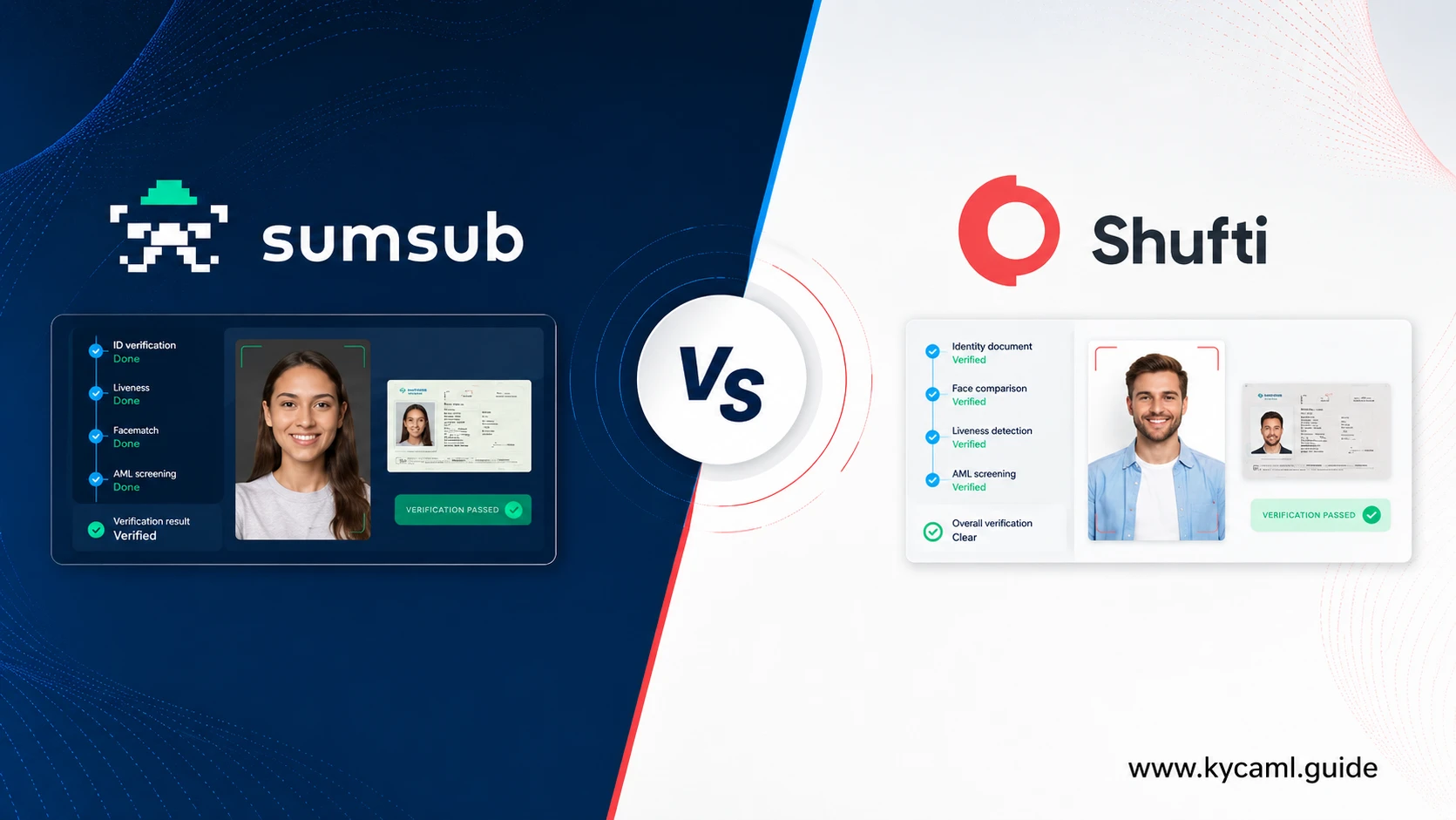
Sumsub accepted 80% of fake documents in KYC AML Guide testing. Alongside a Trustpilot rating of 1.3/5 driven by support complaints, that figure prompts a growing number of compliance teams to evaluate the best Sumsub alternatives before renewing or signing.
Switching is not cost-free, so the question is whether an alternative actually fits your context. This article covers eight identity verification companies that appear regularly on shortlists alongside Sumsub, each assessed against the same independent testing data.
How KYC AML Guide Evaluated These Vendors
KYC AML Guide independently tested 13+ vendors using a standardised set of genuine and fraudulent identity documents. Results are reported as percentages. Testing also covered backoffice UX, mobile KYC journey quality, support responsiveness across off-hours and public holidays, and a compliance certification audit across 37 major standards. Vendors without sufficient independent data are noted and placed lower in this list.
Eight Sumsub Alternatives, Compared
Jumio
Founded in 2010 in Palo Alto, Jumio reports approximately $264M in annual recurring revenue (market estimate) and holds a Gartner Magic Quadrant Leader position. Reference clients include HSBC, Airbnb, Binance, United Airlines, and FanDuel.
Jumio achieved 0% fake document acceptance in KYC AML Guide testing. It carries 15 compliance certifications, tied for the highest count in the tested pool. Its Identity Graph draws on 30M+ known identity records (vendor-reported) and provides network-effect fraud intelligence. For businesses facing repeat fraudsters across multiple merchant environments, that cross-merchant intelligence is a genuine differentiator.
The weaknesses are documented. Jumio’s backoffice UX was rated among the most outdated in testing, and developers consistently report a steep integration learning curve. Localization gaps in LATAM markets, particularly Brazil, appear across multiple client reviews. Per-feature pricing makes total cost of ownership difficult to forecast without a full scope.
Best for: Enterprise financial institutions where Gartner recognition matters for internal procurement approval and high-fraud environments where the Identity Graph’s cross-merchant intelligence compounds over transaction volume.
Onfido (Entrust)
Onfido was acquired by Entrust in 2024 and continues as a full-featured identity verification platform for consumer-facing onboarding. It accepted 10% of fake documents in KYC AML Guide testing, the second-best result in the tested pool.
Onfido’s strongest data point in testing is mobile UX. It ranked in the top three for mobile KYC journey quality across evaluated vendors, which matters directly for products where onboarding conversion rates are linked to verification experience.
Pricing scales steeply at volume. Mid-market buyers report significant cost increases as verification numbers grow. Post-acquisition product roadmap continuity is a legitimate open question for buyers committing to long-term contracts.
Best for: Mobile-first consumer products and gig economy platforms where onboarding UX quality directly affects activation rates and a 10% fake document acceptance rate falls within your fraud tolerance.
Veriff
Founded in 2015 in Tallinn, Veriff is profitable and reports $100M+ ARR (vendor-reported). Its document catalog at 12,000+ types (vendor-reported) is the largest among tested vendors. Known clients include Uber, Western Union, Bumble, and Visa.
Veriff accepted 30% of fake documents in KYC AML Guide testing. It is cloud-only (AWS Ireland), a structural disqualification for buyers with data sovereignty requirements. Its CrossLinks fraud network, which flags known patterns across Veriff’s full client base, is a genuine differentiator for high-volume consumer platforms. That same feature creates lock-in: fraud intelligence built on Veriff data does not transfer if you switch vendors.
Client reviews flag mid-contract repricing as a recurring issue. Veriff also blocks China, Vietnam, and Iran, which is a deal-breaker for global platforms expanding into those markets.
Best for: Consumer platforms in English-language markets where CrossLinks network intelligence compounds over time and UK DIATF certification is a specific regulatory requirement.
Shufti
Founded in 2017 in London, Shufti covers 240+ countries and territories across 150+ languages (vendor-reported). It achieved 0% fake document acceptance in KYC AML Guide testing, tied with GBG and Jumio (alphabetical order).
The structural differentiator among alternatives: Shufti is the only vendor in the tested pool offering on-premises deployment alongside cloud, local cloud, and hybrid options. For buyers in data-sovereign jurisdictions, this removes most of the shortlist from contention.
Shufti’s backoffice ranked first in KYC AML Guide testing for audit transparency, billing visibility, and verification detail. Its non-Latin OCR has been independently benchmarked against Google Vision: Arabic at 92.17% (vs. 90.24%), Vietnamese at 96.79% (vs. 82.36%), and CJK scripts at 86.87% (vs. 82.89%). These benchmarks are Shufti-specific and were not conducted with an equivalent methodology for other vendors in the pool. They speak to Shufti’s performance on those scripts, not to a cross-vendor ranking.
The trade-offs are concrete. Data retention is 2 years, compared to Sumsub’s 5-year policy. Buyers with multi-year regulatory audit cycles need to verify whether 2 years satisfies their specific obligation. The document catalog at 10,000+ types (vendor-reported, framed as actively verified in production monthly) is lower on raw count than Veriff (12,000+) and Sumsub (14,000+). Mobile UX ranked below the top five in testing, with responsiveness issues observed on some devices. Shufti holds 13 compliance certifications, below Jumio and Sumsub (both at 15).
Best for: Buyers with data sovereignty mandates requiring on-prem deployment, MENA and APAC operations where non-Latin OCR accuracy is a hard requirement, and cost-sensitive buyers who need pay-as-you-go pricing with no monthly minimums (free tier available, vendor-reported).
Trulioo
Founded in 2011 in Vancouver, Trulioo ranked first for support in KYC AML Guide testing across all vendors evaluated. Its ticketing system, self-initiated follow-ups on pending queries, and proactive mobile outreach at off-hours outperformed every other tested vendor on this dimension.
That support quality comes alongside a significant data point: Trulioo accepted 70% of fake documents in KYC AML Guide testing, the second-highest rate in the tested pool. Its data retention policy is 72 hours, the lowest of any tested vendor and a structural compliance problem for buyers in jurisdictions requiring extended data storage for AML audit purposes.
Trulioo’s primary advantage is database verification coverage, drawing on local data sources in markets where document-based checks carry friction or where name and date-of-birth matching is the primary check type.
Best for: Enterprise buyers where procurement support, account management, and onboarding process carry significant weight, and markets where database verification breadth is the primary requirement. Not appropriate for buyers requiring AML-compliant data retention beyond 72 hours.
Incode
Founded in 2017 in San Francisco, Incode has deep roots in LATAM markets and ranked second for support in KYC AML Guide testing. Before the first call, Incode’s team verified the tester’s company identity via their contact form and reached out proactively. That pre-sales due diligence was the most thorough observed in the tested pool after Trulioo.
Incode relies on Microblink for document scanning, which introduces third-party dependency into its technology stack. Independent testing data for Incode outside LATAM document types is limited, and multi-year contract lock-ins appear in market reviews.
Best for: LATAM-focused operations and enterprise buyers for whom relationship management and pre-sales rigor are genuine evaluation criteria. Limited independent data available outside LATAM coverage.
GBG (GB Group)
GBG, founded in 1989 in Chester, UK, achieved 0% fake document acceptance in KYC AML Guide testing, tied with Jumio and Shufti (alphabetical order). Its database verification depth in UK, EU, and APAC markets is a competitive strength in those geographies.
The geographic constraint is significant. GBG’s database-only architecture misses markets with thin bureau coverage: MENA, LATAM, and Southeast Asia. A market estimate suggests 30–40% of addresses in those regions are not reliably verified by database-only methods (market estimate). Global platforms typically require a supplementary vendor alongside GBG.
Best for: UK, EU, or APAC enterprise buyers in banking, insurance, or public sector where database depth is the primary requirement and a 0% fake acceptance result is a baseline filter.
IDnow
Founded in 2014 in Munich, IDnow specialises in EU/DACH regulatory markets. It ranked third for support in KYC AML Guide testing, with strong pre-sales due diligence that included verifying the tester’s company identity before granting demo access.
IDnow’s video-ident capability provides human-assisted video verification that carries specific compliance weight in Germany, Austria, and Switzerland, where video KYC is embedded in local regulatory frameworks. It also offers a verification wallet product.
Outside EU/DACH markets, IDnow is less competitive on geographic coverage and feature breadth. Independent testing data outside European document types is limited.
Best for: Regulated businesses in Germany, Austria, or Switzerland where video-ident is a compliance requirement. Limited independent data available outside EU documents.
Head-to-Head Comparison
| Vendor | Fake Doc Acceptance | Deployment | Document Types | Data Retention | Compliance Certs |
| GBG | 0% (KYC AML Guide testing) | Cloud | Not disclosed | Not disclosed | Not audited in latest cycle |
| IDnow | Limited independent data | Cloud | Not disclosed | Not disclosed | Not audited in latest cycle |
| Incode | Limited independent data | Cloud | Not disclosed | Not disclosed | Not audited in latest cycle |
| Jumio | 0% (KYC AML Guide testing) | Cloud | 5,000+ (vendor-reported) | Not disclosed | 15 (KYC AML Guide audit) |
| Onfido | 10% (KYC AML Guide testing) | Cloud | Not disclosed | ~3 years (vendor-reported) | Not audited in latest cycle |
| Shufti | 0% (KYC AML Guide testing) | Cloud / On-Prem / Local Cloud / Hybrid | 10,000+ (vendor-reported) | 2 years (vendor-reported) | 13 (KYC AML Guide audit) |
| Sumsub | 80% (KYC AML Guide testing) | Cloud-only | 14,000+ (vendor-reported) | 5 years (vendor-reported) | 15 (KYC AML Guide audit) |
| Trulioo | 70% (KYC AML Guide testing) | Cloud | Not disclosed | 72 hours (vendor-reported) | Not audited in latest cycle |
| Veriff | 30% (KYC AML Guide testing) | Cloud-only | 12,000+ (vendor-reported) | 3 years (vendor-reported) | Not audited in latest cycle |
Which Alternative Fits Your Situation?
Fake document accuracy is the primary filter
Three vendors in the KYC AML Guide tested pool achieved 0% fake document acceptance: GBG, Jumio, and Shufti. Each fits a different buyer context. GBG is strongest in UK/EU/APAC markets with database-depth requirements. Jumio suits enterprise financial institutions with complex fraud networks. Shufti fits global platforms with data sovereignty constraints or MENA/APAC geographic focus. Onfido, at 10%, is the next closest result in the pool. If fraud detection accuracy is the primary filter, the buyer context determines which vendor warrants the deepest evaluation.
You operate in a data-sovereign jurisdiction
Sumsub, Veriff, and most alternatives here are cloud-only. Among tested vendors, Shufti is the only option with on-premises, local cloud, and hybrid deployment alongside cloud. If your regulatory environment requires on-prem, the viable shortlist from the tested pool narrows significantly.
Your product is mobile-first
Onfido ranked in the top three for mobile KYC journey testing. Its 10% fake acceptance rate is substantially better than Sumsub’s 80%, and its consumer-facing UX quality is a documented strength. Mobile UX is a noted gap for several alternatives, including Shufti, which ranked below the top five in mobile testing.
You are expanding into LATAM
Incode’s LATAM heritage, biometric architecture, and pre-sales rigor give it a legitimate shortlist position for LATAM-focused operations. Jumio has reported localization issues in Brazil specifically; verify coverage before including it in a Brazil-heavy evaluation.
You need EU/DACH regulatory compliance
IDnow’s video-ident capability, DACH market depth, and pre-sales due diligence make it the first call for businesses in Germany, Austria, or Switzerland where video-based KYC is embedded in local regulatory frameworks.
The Right Choice Depends on Your Constraints
Sumsub is not a weak vendor. It holds 15 compliance certifications, a Gartner Magic Quadrant Leader designation for 2024–2025, the broadest document catalog in the tested pool (14,000+ types, vendor-reported), and a 5-year data retention policy that leads the pool on that metric. For crypto operators, iGaming platforms, and buyers who prioritise analyst-validated procurement and reusable KYC architecture, Sumsub belongs on the shortlist.
For buyers where the 80% fake document acceptance result is a disqualifier, the alternatives above each address different subsets of the problem. Choosing among them requires being specific about which constraint matters most: fraud tolerance, deployment architecture, geographic coverage, mobile UX, or enterprise support process. No single alternative wins across all of those dimensions simultaneously.
KYC AML Guide’s full testing methodology is available at kycaml.guide.
Share