






 14 min Read
 February 24, 2026
Choosing the best identity verification (KYC) software in 2026 feels like walking through a hall of mirrors. If you have spent any time looking for a provider lately, you have likely noticed that every website looks identical. Everyone promises global coverage, claims to support 15,000+ documents, and boasts about AI-powered identity verification that works in under 60 seconds. In a market this saturated, best-in-class has lost its meaning.
When you’re looking for KYC software, it’s not about the number of awards they have on their website. Rather, it’s about identifying the customer identity verification software whose technical architecture aligns with your unique customer onboarding and compliance needs. This blog breaks down the real challenges shaping today’s IDV market and outlines a practical framework for evaluating identity verification solutions to optimize your onboarding flow.
The Transparency Problem
For any buyer, one of the biggest roadblocks in the KYC industry is the absence of standardized, global benchmarks, where many of the accuracy claims are validated using the vendor’s proprietary data sets. Therefore, when the vendor states that they have an accuracy level of “99%,” that assertion may not reflect the reality of what your customers will experience, given that you will have different types of identification documents and lighting conditions. Many widely used review grids are more about marketing spend than technical merit.
To make a smart choice, we have to look past the badges and focus on the four core pillars of IDV:
- Face matching
- Document verification
- Doc-free/eIDV checks
- NFC-based verification.
While these four technologies form the operational stack, they structurally collapse into three strategic layers
The Three Layers of Identity Stack
To build a resilient identity stack, a modern identity verification platform must perform across three structural layers, each solving a fundamentally different trust problem:
- Identity Proof: Is there a real human behind the session?
- Identity Ownership: Is the document and data original?
- Authenticity Validation: Can the identity be verified against a trusted source?
1. Ownership: Can You Actually Tell a Human from a Deepfake?
While often the most visible part of onboarding, face verification is no longer just about matching a selfie to a photo. It is an active battleground against generative AI and deepfake fraud.
The Liveness Factor: The highly commoditized ‘face matching’ remains important; a differentiating factor will ultimately be the ability of vendors to identify both sophisticated deepfakes and presentation attacks.
The Performance Myth: Despite using identical criteria to evaluate vendors in a controlled environment, none of them is superior to one another. Vendors’ failures should be considered negligible given that 0.1% variance is considered within acceptable limits.
2. Proof: The Hidden Risks of Outsourced OCR
The backbone of Know Your Customer remains the physical document, but its reliability depends on the OCR (Optical Character Recognition) engine supporting it.
The Outsourcing Risk: Several vendors obscure their OCR processes by passing your sensitive information off to third parties. This expands your data breach surface and often degrades performance on non-Latin scripts.
The Proprietary Advantage: Prioritize vendors who own their OCR engine. This ensures tighter data privacy, lower latency, and superior optimization for regional document variants.
3. Authenticity: Moving Beyond the Naked Eye
This pillar moves beyond visual inspection to verify the source of truth, either through digital databases or hardware-level encryption.
eIDV (Database-led): Fast, no-document verification using databases to verify personal information. This provides the best user experience; however, this approach works best in jurisdictions with established digital environments, such as the US, Brazil, and the UK.
NFC Chip Validation: Verifying the encrypted chip in biometric passports through your smartphone eliminates the need for visual forgery. It provides the highest level of assurance today and effectively eliminates high-quality physical counterfeits from consideration.
Independent Validation of KYC Vendor Claims
At this point, the obvious question is, how do I actually evaluate these pillars, and how do I know KYC vendors are truly delivering what they claim?
The answer is simple. You don’t rely on demos or sales decks. You run controlled pilot tests in your top markets, measure real-world FRR and completion times, simulate spoof attacks, and compare vendors side-by-side using a structured evaluation framework or vendor comparison tool. Many serious online identity verification solutions providers will permit pilot testing for the purposes of validation; however, few will provide full transparency related to OCR optical character recognition ownership, any sub-processors, and market-specific benchmarking of their solutions.
This is where meaningful differences start to appear. Once this layer of validation is introduced, much of the market confusion disappears. The vendors that can substantiate their claims stand out quickly.
Building Your Truth with a Weighted Scoring Model
Using a weighted scoring model can shift your evaluation from a subjective debate to a disciplined process. Your focus should not just be on which vendors have the greatest number of features, but rather on which vendor performs best based on your priorities.
The framework below offers a structured method for evaluating the vendors in a practical way.
| Evaluation category | Weight | Why this weight? |
| Regional Performance | 25% | The rest of the features are irrelevant if a vendor cannot accurately verify a user in the primary market (for example, due to weak OCR on local scripts). |
| Fraud Resistance | 20% | The weight given to deepfake detection and liveness is high, as the cost of a major ID fraud through the use of deepfake technology can cost more than the entire IDV contract. |
| Tech Ownership | 15% | Vendors that own their core stack can customize workflows based on your risk appetite and compliance obligations while enabling advanced integration flexibility. |
| Compliance Coverage | 15% | Critical in meeting AML/KYC requirements and ensuring that your company will be free of regulatory fines and onboarding of bad actors. |
| UX and Conversion | 15% | A weak safety program is useless if 50% of your users leave the system. The weight of this growth engine provides a balance between safety and revenue through measuring the amount of friction |
| Integration and Support | 10% | A low weight, but critical. Bad documentation or slow support can delay your product launch by months. |
How Leading Identity Verification Solutions Compare by Use Case?
The goal of the comparison below is not to crown a universal winner. It is to illustrate which vendor profiles align with different operational models to help find strategic fit. Identity verification performance is highly contextual, where geography, fraud exposure, regulatory pressure, and UX tolerance all change the equation.
This matrix is designed to understand which architectural strengths matter for your specific business model.
1. Geography-led strategy Alignment
Where Does Your Identity Risk Actually Live?
| Business Scenario | Recommended Strategy | Representative vendors | Why this works |
| U.S.-Focused (High SSN penetration) | Database-First | Socure, Persona | Extensive U.S. identity graph and credit bureau integrations enable high-confidence docless verification. |
| Global Expansion (Multi-country onboarding) | Document-First | Onfido, Incode, Jumio, Shufti | Large document template libraries and automated document parsing support broad international coverage. |
| Emerging Markets (Non-Latin scripts) | Regional OCR Optimization | Shufti, Regional Vendors | Proprietary OCR and localized AI models improve accuracy for Arabic, Cyrillic, Hindi, and other non-Latin scripts. |
| Multi-Region / Complex Routing | Risk-based logic | Alloy, Persona | Risk-based logic ensures high-risk users receive stronger verification while low-risk users move frictionlessly |
2. Risk Tolerance Alignment
Define Your Fraud Tolerance Before Comparing Vendors
| Fraud Tolerance | Operational Objective | Representative vendors | Why this works |
| Ultra-Low Fraud Appetite | Enhanced Identity Assurance with multi-layered verification | Persona, Paravision, Incode, Shufti | Layered document verification, strong biometric defense, and traditional document validation techniques reduce exposure to sophisticated document forgery and synthetic identity fraud. |
| Balanced Risk | Cross-Linking & Fraud Pattern Detection | Veriff, Onfido, Sumsub | Combines document verification, biometric checks, and fraud signal monitoring to balance risk mitigation with user experience. |
| Moderate–Higher Fraud Tolerance | Streamlined KYC Journey Optimization | Shufti, iDenfy, Sumsub | Optimizes the end-to-end verification flow to reduce friction and support higher onboarding completion rates within defined risk thresholds. |
3. UX Tolerance Alignment
How many steps will users tolerate?
| UX Strategy | Primary Flow | Representative Vendors | Why this Works |
| Invisible | ID Doc-Free | Socure, Shufti, Sumsub | Background data checks minimize user interaction and accelerate onboarding. |
| Guided | SDK-Based Self-Service | Persona, Veriff, Sumsub | Real-time prompts reduce user error and drop-off. |
| Hybrid | AI-Powered Identity Verification + Human Review | iDenfy, Shufti | Manual fallback supports edge cases without disrupting user experience. |
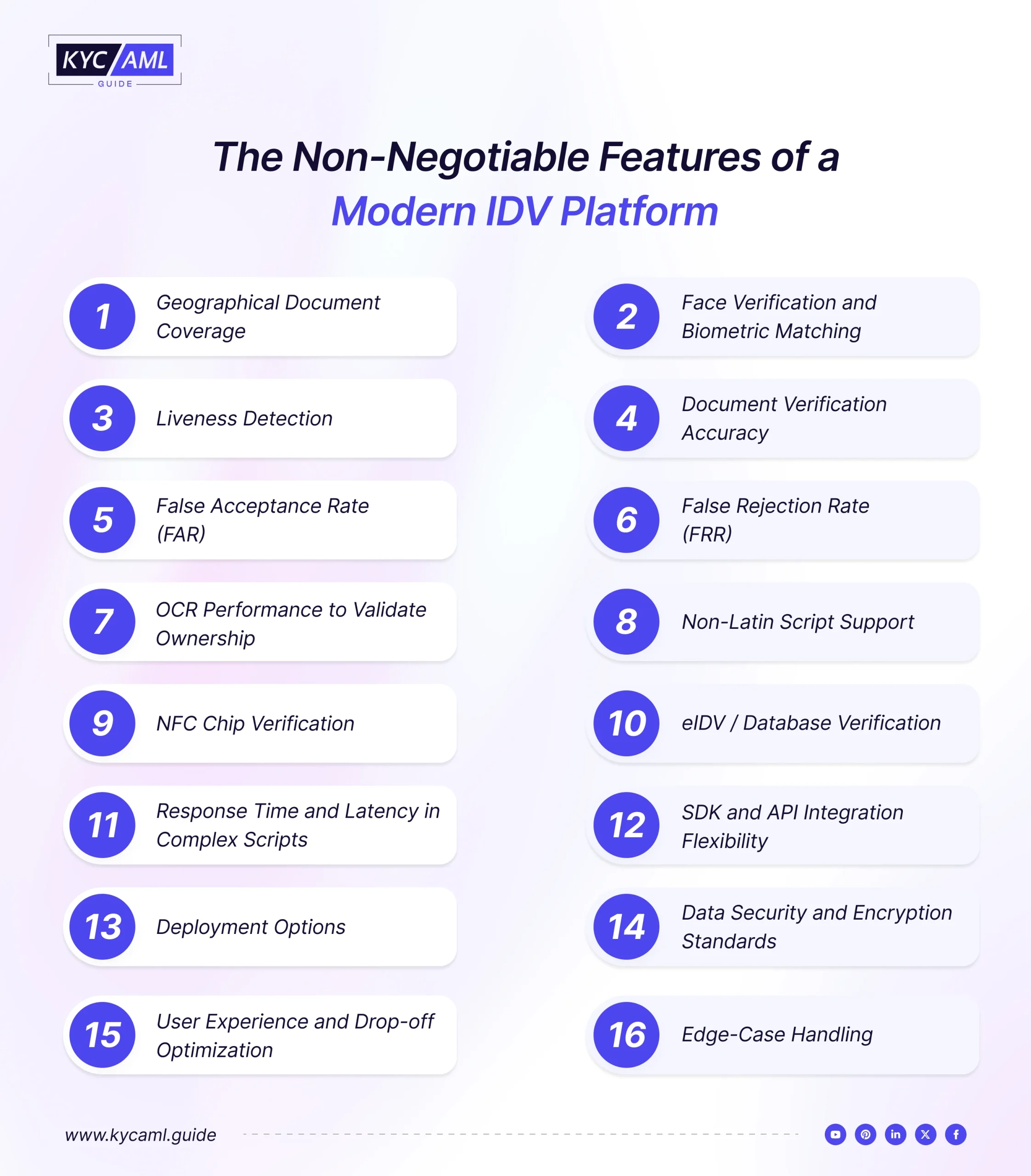
What to Verify Before You Sign Your Next KYC Provider?
The strategy alignment of vendor candidates is simply the first initial filter for selecting vendors.
After strategy alignment is established, you will need to verify that the vendor candidates’ identity verification stack contains operational depth.This checklist is strictly focused on IDV capabilities; it does not take into account broader AML or compliance capabilities and is concerned with the technical capabilities that play a direct role in reducing fraud, increasing conversion rates, and providing long-term scalability.
Conclusion:
When selecting the best identity verification software in 2026, the key will no longer be based on what each vendor claims regarding accuracy, nor will it be based on the number of badges displayed on their website. So, who is the right vendor?
One whose infrastructure aligns with your geography, fraud tolerance, compliance risk, and end-user experience goals. Remove all the branding and conduct actual pilot tests on their applications. Stress-test each vendor’s system. The reason there will be a difference between an easy-to-use onboarding process and a fraud occurrence with identity verification is not the branding but rather the infrastructure of the vendor.
The KYC AML Guide is built to pair the ‘right’ rather than the ‘leading’ KYC solution with your unique business requirements.
Share